You saved a pasta reel on Tuesday. On Friday, you have a pan on the stove and cannot remember whether the sauce needs cream, yogurt, or neither. Finding the video is only half the problem: the detail you need may be in the caption, a pinned comment, or a moment that flashes past.
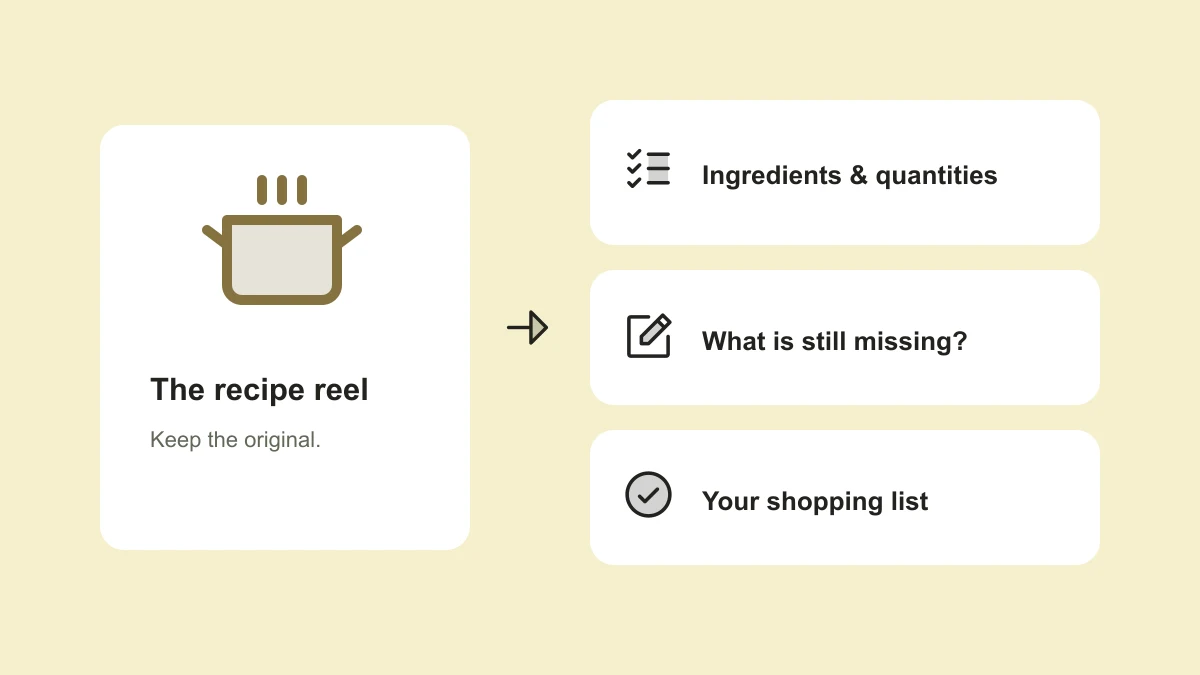
A useful recipe note brings those pieces together before you start cooking. Keep the source, write down the details the creator actually provides, and mark anything you still need to check. This workflow works in an ordinary notes app and does not require a dedicated recipe service.
Find the complete recipe before summarizing it
Start with the original post. Look for quantities and instructions in its caption, then check whether the creator points to a full recipe on their own website. A short video may demonstrate a technique while leaving the written instructions elsewhere. Save both links when they serve different purposes.
Treat a comment from another viewer as a suggestion rather than part of the original recipe. If you cannot confirm an ingredient or a step, write that down. A note that says ‘amount of stock not provided’ is more useful than an invented measurement that looks authoritative.
Record the details you will need with your hands full
Give the note a name you can recognize, such as ‘lemon chickpea pasta from the one-pan reel.’ Include the creator’s name and the reason you saved it. Perhaps it uses ingredients you already have, suits a small kitchen, or demonstrates a sauce you want to learn.
Keep the ingredient list separate from the method. Record quantities, units, servings, equipment, and any timings that the source specifies. Do not assume that a 30-second reel means a 30-second preparation. Make preparation, waiting, and cooking time separate fields if the recipe gives them.
- Ingredients: names, quantities, units, and optional toppings.
- Method: the order of the steps, including preparation before cooking.
- Equipment: pan, tray, blender, or other tools the method depends on.
- Unknowns: anything the post does not explain clearly.
Use a template that makes missing information visible
The example below is a note structure, not a complete recipe. Replace the brackets with information from the creator’s instructions. Leaving an unknown field visible makes it easier to resolve before a shopping trip, rather than discovering the gap halfway through cooking.
Keep your personal changes in a separate field. If you decide to try a different ingredient, label it as your change. That preserves the original method and helps you understand the result when you revisit the note.
Recipe: Lemon chickpea pasta
Original reel: [link]
Full recipe: [creator’s recipe link, if available]
Creator: [name or handle]
Saved because: Uses the chickpeas in my cupboard
Servings: [as stated, or not provided]
Ingredients and quantities: [from the source]
Method: [short steps from the source]
Equipment: [what the method requires]
Timing: [as stated, or not provided]
Still need to check: [missing quantities or steps]
My planned changes: [keep separate from the original]
After cooking: [what I would repeat or change]
Make the shopping list from the note
Check your cupboards against the confirmed ingredient list. Separate ‘already have’ from ‘need to buy,’ and combine repeated ingredients across the meals you plan to make. Keep units attached to quantities so that a package size is not confused with the amount the recipe calls for.
If you change the number of servings, record the change and revisit the method rather than silently replacing the original amounts. Some recipes need more than an arithmetic adjustment. Keep the original link within reach so you can check the creator’s guidance.
Name it for the way you will look for it
Use practical phrases such as ‘one pan,’ ‘chickpeas,’ ‘lunch box,’ or ‘blender sauce’ when they accurately describe the recipe. One or two useful labels will usually help more than a collection called ‘food’ containing hundreds of unrelated saves.
After cooking, add a short personal note: what you liked, which part took longer, and whether you would make it again. You are building your own cooking memory while keeping the creator’s recipe identifiable. Remove ideas that no longer interest you so the collection stays useful.
How recipe notes fit the TapShift idea
We are building TapShift around sharing content, keeping useful notes with their sources, and finding them again through conversation. A future request could be ‘show me the chickpea pasta I saved.’ A recipe note would still be useful without a shopping link or any purchase.
The assistant and messaging integrations are not live yet. Content extraction may also leave details unresolved, so the original recipe remains important. You can use the workflow above today in your existing notes app and join the waitlist to hear when TapShift is ready.
Published by TapShift, a prelaunch project in India. Examples are illustrative. Planned product features are described as plans, and the practical steps can be used independently of TapShift. Send a correction or question.